
This post may contain affiliate links, meaning if you buy or book through one of these links, I may earn a small commission .
If you are taking a trip to coastal Massachusetts to visit witch trials sites, a stop in Danvers, MA is a must. Sitting on the outskirts of Salem and once called “Salem Village”, the very first events of this 1692 tragedy happened here. As tourists often pass over this small town to visit Salem, below I am sharing awesome things to do in Danvers, MA that may not be on your radar.
To be frank, I wasn’t even aware of Danvers until a couple years ago. I’d been taking frequent trips to the Boston area for my husband Aaron’s job, and Salem became one of my favorite day trip destinations. With my curiosity piqued about Puritan history, I bought a 400-page deep-dive into the witch trials called, fittingly, The Witches.
This novel taught me that the witchcraft accusations didn’t actually start in today’s Salem, but in the former rural precinct of Salem Village. I began to wonder what became of this pious Puritan hamlet where so much of the action took place.
In fact, Salem Village has simply become Danvers, and is an essential stop when visiting Massachusetts to see witch trials sites. Below are the top sites to see in Danvers, MA, all of which relate to these tragic 1692 events.
6 Best Things to Do in Danvers, MA (aka Salem Village)
Below are the best places to see in Danvers, MA, including two rare gems: a home and a gravesite related to two different witch trials victims.
1. Rebecca Nurse Homestead

The number one thing to do in Danvers, MA is to visit The Rebecca Nurse Homestead. Rebecca’s husband leased the property in 1678, where they lived together with a few of their eight children. A respected 71-year-old grandmother, Rebecca’s execution is one of the most shameful of the witch trials.
Rebecca was ill and lying in bed when she was arrested for witchcraft. Her accuser was 12-year-old Ann Putnam Jr., daughter of a prominent local family. This preteen girl would go on to name eighteen of the twenty people eventually executed during the trials.
The artifacts in the home are not original to the family, but do date back to the 17th century. Be sure to check out the house’s archeological display, where you can find plates, jars, and other items that were dug up on the property.
Besides the red wood-sided house, there are several other buildings on the site. This includes a replica meeting house, gift shop, and small dairy stands (some of these structures may be closed). There will also be staff members on site to answer any questions.
Note that the Rebecca Nurse Homestead has very limited hours and the schedule changes seasonally. Check here for the latest opening times.
Read Next: 13 Wicked Things to Do in Salem, MA in October
2. George Jacobs Grave Site

Do not leave the Nurse Homestead before making your way to the family cemetery. Per Nurse family tradition, Rebecca’s husband and son secretly buried her here after her execution. There is a monument honoring Rebecca and the 40 individuals who risked their reputation and freedom by testifying to her innocence.
Additionally, you’ll find the grave of George Jacobs, who was executed at 81 years old after his servant accused him of witchcraft. The Fowler family discovered Jacobs’s remains on his old property, which they had purchased, in 1864. His gravesite was later moved to the Nurse Family Cemetery in 1992.
Upon being questioned, Jacobs famously said, “You tax me for a wizard. You may as well tax me for a buzzard!”. Sadly, this is the only known gravesite of any of the twenty-five Salem Witch Trials victims (five died in jail).
3. Witchcraft Victims’ Memorial
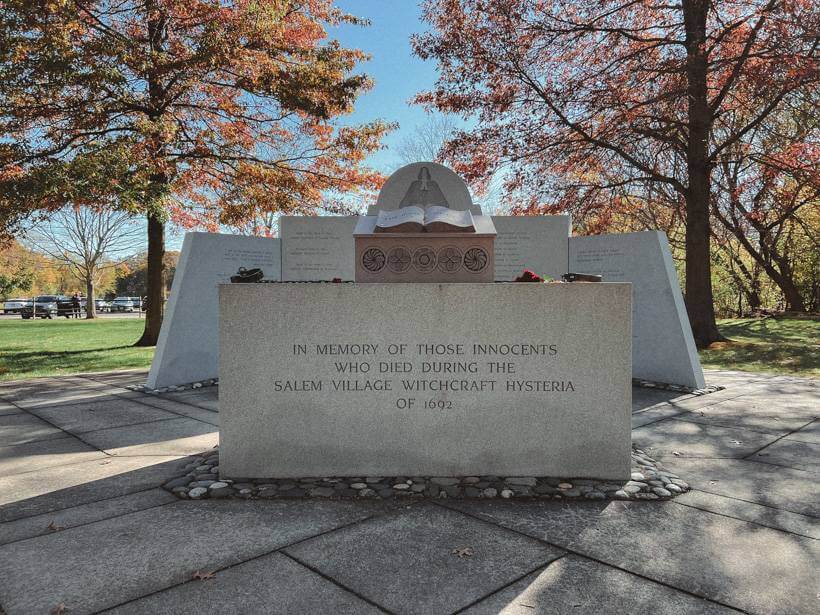
While the more famous Witch Trials Memorial is in Salem, Danvers has its own memorial to the twenty-five people who died in 1692. Both memorials were erected in 1992, or 300 years after the witch trials ended.
Note the three-panel granite wall that names each victim, their date and cause of death, and includes several of their impassioned quotes from the hearings. The park near the monument is a good place to leave your car to do a little walking. This general area was where much of the action of 1692 took place, and contains the following three important sites.
4. Ingersoll’s Tavern

Facing Hobart Street at the Witch Victims’ Memorial, cross the road and turn left to find an unassuming old building that lies vacant. This seemingly neglected house is the former Ingersoll’s Tavern, which dates back to 1670.
This tavern was often the center of the action during the witch trials, as Salem Village residents congregated here for a pint in between hearings at the meeting house. Although feigned, several townspeople saw spectres and witnessed their “bewitched” neighbors experience afflictions on this property. Several accused individuals, including Rebecca Nurse, were held at Ingersoll’s prior to their hearings.
In 1701, tavern-owner Nathaniel Ingersoll provided land for Salem Village to build their second meeting house across the street, where a modern church now stands. Unfortunately, the building that once housed the tavern is not currently open to the public. However, you can still envision from the outside what the atmosphere must have felt like here in 1692.
5. Original Salem Village Meeting House

The first Salem Village meeting house once stood on the corner of Hobart and Forest Streets, across from the Witchcraft Victims’ Memorial. This was the site of several early examinations of the accused during the witch trials, after Ingersoll’s proved too small a space for the crowds that turned up to watch. While the structure no longer exists, you can still see a sign marking when it once stood.
You may have noted that Salem Village’s second meeting house was built only nine years after the witch trials. So, what happened to the first one?
At the turn of the 18th century, Salem Village was ready for change and abandoned their old meeting house. Not only did the growing community need a bigger space, but the townspeople wanted to forget the sour memories the space still held.
Ownership of the wooden structure fell to Joseph Hutchinson, who used it as a barn. In the words of Charles Upham, former mayor of Salem and author of Salem Witchcraft: “…it was used as such until, in the memory of old persons now living, it mouldered, crumbled into powder-dust, and sunk to the ground”.
6. Salem Village Parsonage Ruins

Built in 1681, the minister who served during the witch trials, Samuel Parris, lived in the parsonage with his wife, their three children, niece, and two slaves. Parris’s 9-year-old daughter Betty became the village’s first “bewitched” person in January of 1692 when she started exhibiting strange behaviors.
Betty’s cousin, Abigail Williams, who also lived in the house, followed suit and became one of the initial main accusers at the beginning off the trials. Parris’s slave, Tituba, was among the first of the accused. In fact, she fanned the flames of the hysteria when her riveting confession named several other innocent woman as witches.
By 1784, the structure has declined and become uninhabitable, so the old parsonage was razed. The ruins were hidden under a pasture until 1970, when local historian Richard Trask uncovered them with a team of archeologists. Today you can still see the foundations of the cellar that once existed under a couple rooms of the house.
• • •
That covers the top places to visit in Danvers, MA, where you can journey through what remains of the former Salem Village. If you are traveling to discover witch trials history, a stop in Danvers is essential to any Massachusetts itinerary!