
This post may contain affiliate links, meaning if you buy or book through one of these links, I may earn a small commission .
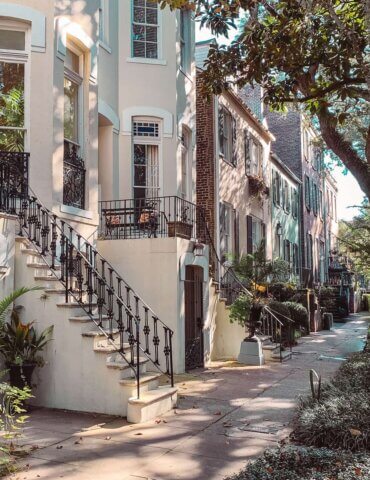
Does the thought of walking through buildings and paths that existed during, and even before, the American Revolution thrill you? Then make your way down to the Lowcountry to explore the beautifully preserved historical sites of Savannah, GA.
Since James Oglethorpe founded this colonial city in 1733, it has been witness to almost three centuries’ worth of events. Because of this, just about everything in Savannah’s Historic District has a story behind it. There is much to see in its twenty-two squares, which make up the nation’s largest National Historic Landmark District.
By simply taking a walk through Savannah, you are walking in, along, and over top of history.
To really get to know Savannah, you’ll want to tour some of the beautiful homes and sites where early Savannahians went about their daily lives. To get you started, here are eleven of the top historical sites to visit in Savannah, GA. As many of these are located nearby one another, it’s possible to cross several off your list with just a quick weekend in Savannah.
Must-See Historical Sites in Savannah, GA
For fun, I’m listing out these historical sites from oldest to newest. Most are right in downtown Savannah, but a couple are just a short drive or Uber outside the city.
6 Original Colonial Squares

Savannah was designed from its inception as a planned city with twenty-four squares. Twenty-two of those survive today, with two being lost as the city grew and modernized.
Oglethorpe personally took part in laying out the first six squares. Originally, their primary use was for militia training, but today they serve as green spaces full of historical and cultural value.
- Johnson Square: The first of Savannah’s squares and at one time the city’s social and commerical hub.
- Ellis Square: Historically was home to four public markets. Sadly, a parking garage was built over Ellis Square in the 1950’s. It was restored with a modern design in 2010 when the parking garage was moved underground.
- Oglethorpe Square: A simple green space in close proximity to many restaurants, as well as the Owens-Thomas House & Slave Quarters.
- Reynolds Square: Named after the first Royal Governor of Georgia, this is the site of The Olde Pink House restaurant.
- Telfair Square: Where you can visit the esteemed Telfair Museum of Art and Jepson Center for the Arts. Trinity United Methodist Church, the oldest Methodist congregation in Savannah, is also located here.
- Wright Square: View the Gordon Memorial and burial site of Tomochichi, a Yamacraw Chief who was instrumental in helping Oglethorpe build his settlement in Savannah.
Tomochichi’s Grave Site

When General Oglethorpe landed in what would become Savannah in 1733, he was greeted by Yamacraw Chief Tomochichi. Tomochichi was welcoming, and worked with the colonists in building their new city.
This included planning out important roads and establishing diplomatic relations with neighboring tribes. Tomochichi even made a trip to England with Oglethorpe in 1734. The two men went on to work with one another for years until Tomochichi’s death in 1739.
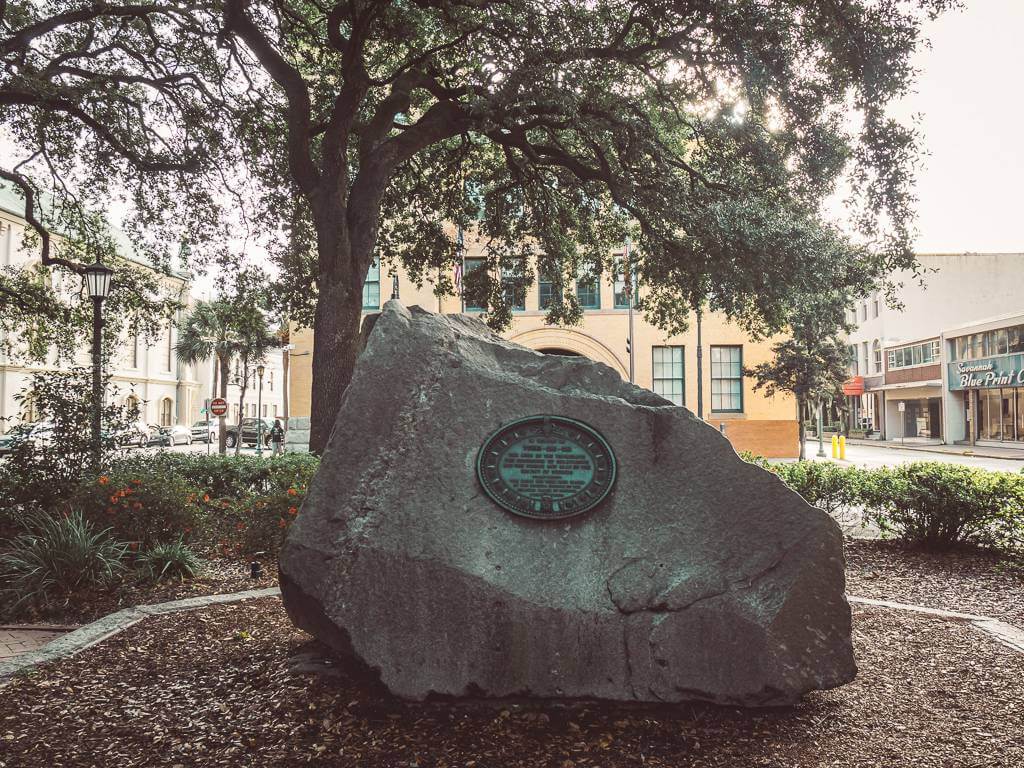
When Tomochichi died, Oglethorpe held a military funeral to honor him in Wright Square. A traditional pyramid of stones served as a monument above his grave.
Over time, possibly due to deteriorating relations with Native Americans or simply bad record keeping, Tomochichi’s pyramid was removed. In 1883, a monument to William Washington Gordon was placed in the pyramid’s former location, right over top of Tomochichi’s grave.
Community members, including Gordon’s daughter-in-law, Nellie Kinzie Gordon, spoke out about this. This prompted a new granite boulder to be added to Wright Square in Tomochichi’s honor in 1899.
The Pirates’ House
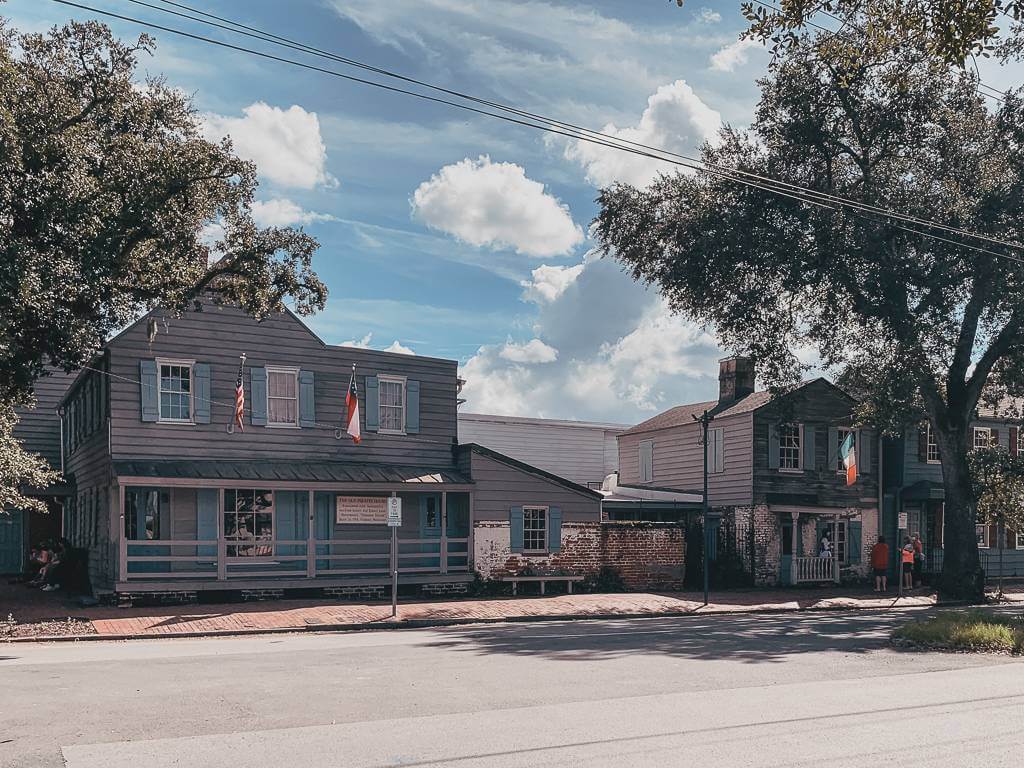
Opened in 1753, The Pirates’ House is the city’s oldest standing structure. As Savannah grew into a bigger port town, this tavern and inn became necessary to cater to the many sailors coming in and out of town.
Rumor has it there were once tunnels under the building, used by pirates to smuggle drunken men to work on their ships. Robert Louis Stevenson even found inspiration at The Pirates’ House, and mentions it in his book, Treasure Island.
Today, The Pirates’ House primarily serves as a restaurant, and is a bit of a tourist trap. However, the original restored structure still stands, and is definitely still a cool place to check out. If you ignore the children eating chicken tenders from the lunch buffet, you can really imagine some salty sailors taking swigs of hard liquor inside this building.
20 E Broad St, Savannah, GA 31401; reservations recommended
The Olde Pink House

One of my favorite stops in Savannah, The Olde Pink House is one of the best restaurants for a memorable dining experience. Built in 1771 for James Habersham Jr., the house gets its name and fame from it’s rosy exterior.
Despite layers of white paint and plaster, the stubborn red brick underneath would continually bleed through, turning the house pink. Finally, in the 1920’s a woman who bought the house as a tea room decided to embrace the color, and simply painted it pink.
Throughout its history, The Olde Pink House has held secret meetings to discuss America’s fight for independence, served as Georgia’s first bank, and was a General’s headquarters during the Civil War.
Today, The Olde Pink House is a classy restaurant that serves modern spins on traditional Southern cuisine, like their “BLT” salad with fried green tomatoes. Dinner prices here run a bit high, but the excellent service, delicious food, and historical ambiance make the experience worth every penny.
Reynolds Square, 23 Abercorn St, Savannah, GA 31401; reservations recommended
Owens-Thomas House & Slave Quarters

There are so many house museums in Savannah that you could choose to tour. However, the Owens-Thomas House is one of the most worth your time and money.
This grand estate was built for the Richardson family in 1819, but when hardship hit Savannah, they subsequently left town for Louisiana. Next, it served as a boarding house owned by Mary Maxwell, which once housed The Marquis de Lafayette during his 1825 tour of the United States. Finally, the Owens family purchased the house in 1830, and there it stayed until the last heir passed away in 1951.
Today, the house is part of Telfair Museums, with an admission ticket also granting access to the Jepson Center and Telfair Academy sites. Telfair has taken a lot of care with the Owens-Thomas House to provide a streamlined, yet in-depth presentation about what life in the house was like.
This includes a look into the lifestyles of both the families and enslaved people who lived there. The tour does a great job of exhibiting the stark contrast of those who inhabited the slave quarters verses the owners who benefitted from modern amenities like running water and ice.
Location: Oglethorpe Square, 124 Abercorn St, Savannah, GA 31401; $20 for adults, $15 for students 13-25, $5 for kids 6-12
Travel Savvy Tip
A good way to see a lot of historical sites in Savannah, GA at once is to take a walking tour. While there are plenty of companies to choose from, we found Savannah Dan to be highly entertaining and knowledgeable. He also gives excellent dining suggestions!
Andrew Low House
The family home of Andrew Low, who was once the wealthiest man in Savannah, and father-in-law of the woman who would go on to found Girl Scouts of the USA. Andrew Low first commissioned the house to be built in 1848, and it stayed in the family until Juliette Gordon Low’s death in 1928.
Since 1950, this stately home has been open to the public to tour. A visit will take you through the beautifully built and well-preserved mansion that has entertained many people over the years, including Robert E. Lee. The house is filled with rare period furnishings, family portraits, and other belongings of the Low family.
Lafayette Square, 329 Abercorn St, Savannah, GA 31401; $12 per adult, $11 for students ages 6-18
Marshall House
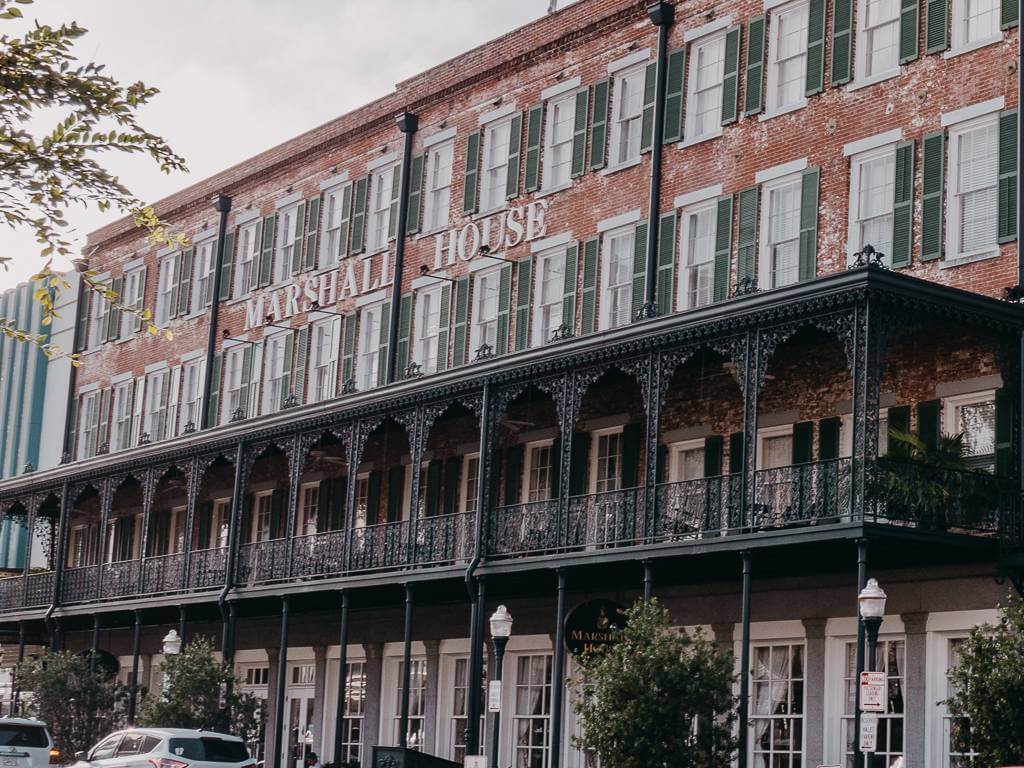
One way to guarantee you’ll immerse yourself in some history while in Savannah is to stay somewhere historic. Marshall House was first built as a hotel in 1851, but it soon began to serve beyond it’s original purpose.
With two subsequent yellow fever epidemics and the Union occupation of Savannah in the mid 1800’s, Marshall House temporarily transformed into a hospital. Some people believe that the spirits of some of the deceased never left the hotel. Therefore, Marshall House is also rumored to be one of the most haunted places in Savannah.
Though ghost stories continue to run rampant, today it continues to be a very sophisticated and well-located hotel. My husband and I stayed at Marshall House on a visit, and loved being able to walk everywhere in downtown Savannah. The free breakfast for two and complimentary nightly wine pour doesn’t hurt either!
123 E Broughton St, Savannah, GA 31401
Mercer Williams House

The Mercer Williams House is another fascinating house museum to check out in Savannah. This is especially true for those who have read Midnight in the Garden of Good and Evil, as it is a significant setting in the book.
Completed in 1868, the house was built to be the family home of General Hugh W. Mercer, the great-grandfather of beloved musician Johnny Mercer. However, after the Civil War caused construction delays, General Mercer sold the house before his family ever lived in it.
Jim Williams later purchased the house in 1969. He was an antiques dealer who restored many of Savannah’s most admired mansions.
Before Mr. Williams’s subsequent legal battles, he filled the house with exquisite finds from around the globe. Many items from his private collection are still on display for tour groups today.
Monterey Square, 429 Bull St, Savannah, GA 31401; $12.50 per adult
Congregation Mickve Israel
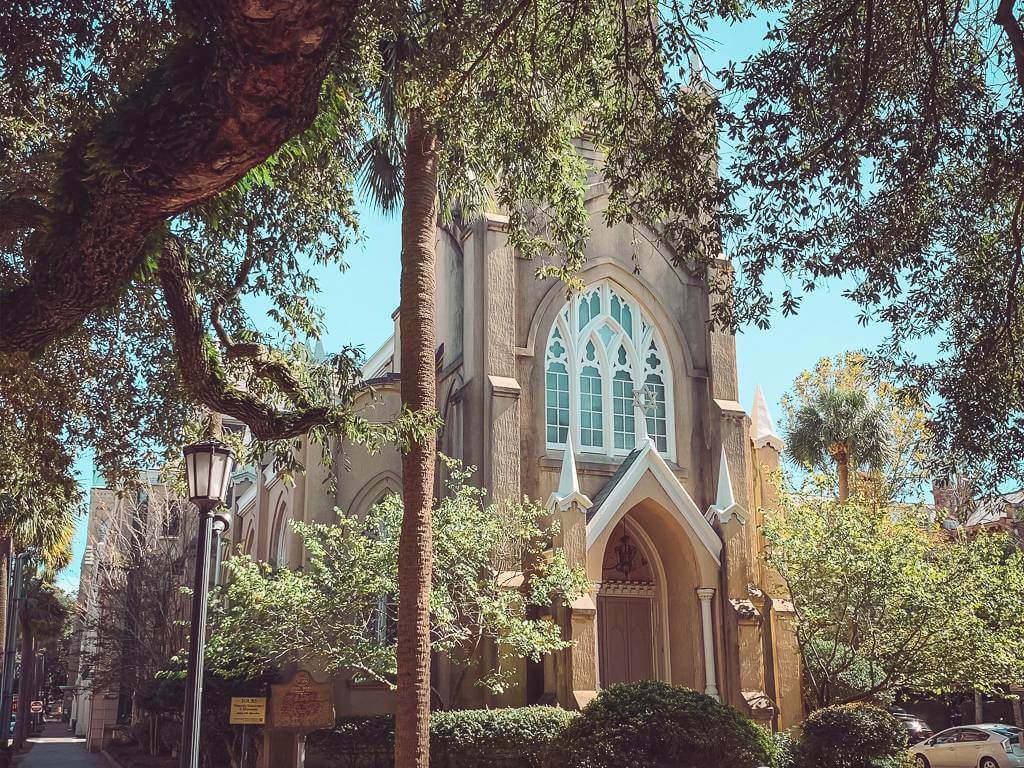
Mickve Israel is the third oldest Jewish congregation in the U.S. The first Jewish settlers arrived in Savannah in 1733, where they could freely practice their faith. Shortly after, they built Georgia’s first synagogue.
Eventually, the congregation outgrew the original building, and a new one was built in Monterey Square. This synagogue dates back to 1878, and continues to offer weekly services today.
Congregation Mickve Israel is open Monday through Friday for the public to tour. Over fourty-five minutes, visitors can admire the building’s neo-Gothic architecture, view historical artifacts from the congregation’s early days, and learn all about Mickve Israel’s fascinating history.
Monterey Square, 20 E Gordon St, Savannah, GA 31401; Tours are $8 per person
Historical Sights Outside Downtown Savannah, GA
Some of the best historical sites in Savannah, GA are not right downtown, but require just a short drive. If you’re willing to branch out, the below two spots are definitely worth your time.
Wormsloe Plantation
Officially called Wormsloe State Historic Site, this is where you can find the ruins of a tabby house built in 1745. The property belonged to Noble Jones, a carpenter from England who travelled to Savannah with James Oglethorpe in 1733.
Wormsloe is also famous for its Instagrammability, thanks to grand rows of live oaks that dramatically line its driveway. The twisting branches form almost a tunnel over this beautiful road.
Though there isn’t much left of the actual structure to tour, there are exhibits of artifacts excavated from the grounds and miles of nature trails to explore. The site also holds special events on occasion, which include presentations demonstrating colonial life.
7601 Skidaway Road, Savannah, GA 31406; $10 per adult, $4.50 for youth ages 6-17, $2 for children under 6
Bonaventure Cemetery
One of the most beautiful cemeteries in the country, Bonaventure Cemetery sits on 103 acres of what was formerly Bonaventure Plantation. The need for this cemetery became apparent when the existing ones in downtown Savannah began to overflow.
Bonaventure has been used as a final resting place and green space by locals throughout its history. Tourists visit the cemetery today for its large, beautiful monuments, and to hear tales of the Savannahians who lay at rest there (including Noble Jones and Johnny Mercer).
Be sure to also check out the Jewish Chapel, which includes a Holocaust memorial for the ashes of 334 victims brought there in 1950. The parcel of land was purchased by the Mickve Israel congregation in 1909 for Jewish burials, and continues to be used today.
330 Bonaventure Rd, Thunderbolt, GA 31404; Admission is free
• • •
There are unlimited ways to get lost in the many historical sites in Savannah, GA. The hardest part will be deciding which ones to pick in your limited amount of time. However, if you choose anything from this list, you will not be disappointed and will learn so much about what makes Savannah the enchanting destination it is today.